System Architecture
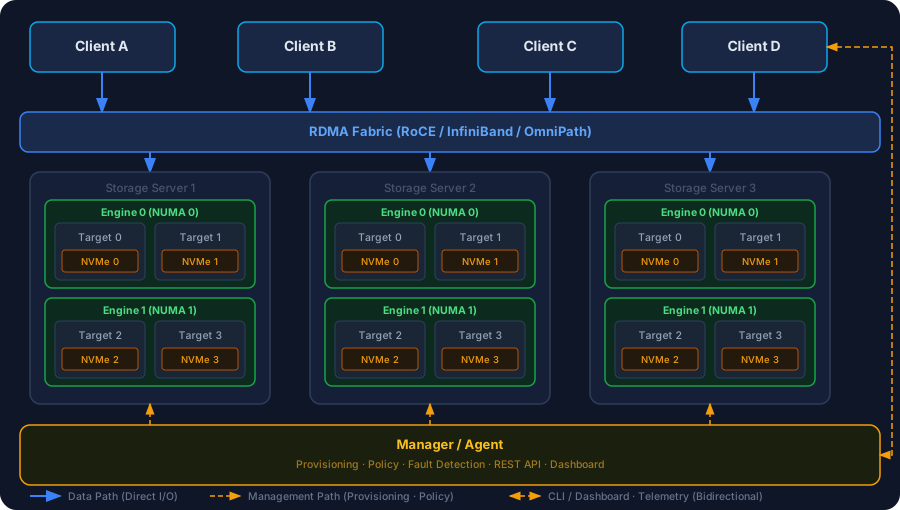
MASS is MangoBoost's storage appliance for shared application data and LLM inference caches. It combines NVMe storage nodes, a storage network, and centralized management through the Dashboard and CLI.
Two Storage Services
| Service | Purpose | Access |
|---|---|---|
| File & Object Storage | Store datasets, checkpoints, and application output | Filesystem mounts or object APIs |
| KV Cache Store | Retain and share KV cache for reuse during LLM inference | An inference engine integration on each GPU server |
File and object storage retains application data under a selected protection policy. A KV cache store holds computed data that an inference engine can regenerate when it is unavailable. These different requirements shape how each service stores and retrieves data.
Data Access
Clients communicate with storage nodes over the storage network. File and object clients access distributed data through their storage client software. GPU servers read and write KV cache pages over NVMe-oF.
Storage management is separate from these reads and writes. Application data does not pass through the Dashboard or CLI.
Management
Administrators use the Dashboard to configure storage, manage access, and view capacity, performance, and health. The mass-ctl CLI connects client machines to the storage they are allowed to use.
See Storage Management for the relationship between storage resources, client access, and monitoring.